A lot of teams upgrade their CRM…but they never assign a product owner.
And that’s exactly why the same problems keep showing up.
So what is a “product owner” in the context of a CRM?
A Product Owner is the person who owns the business side of the CRM, not the technical side.
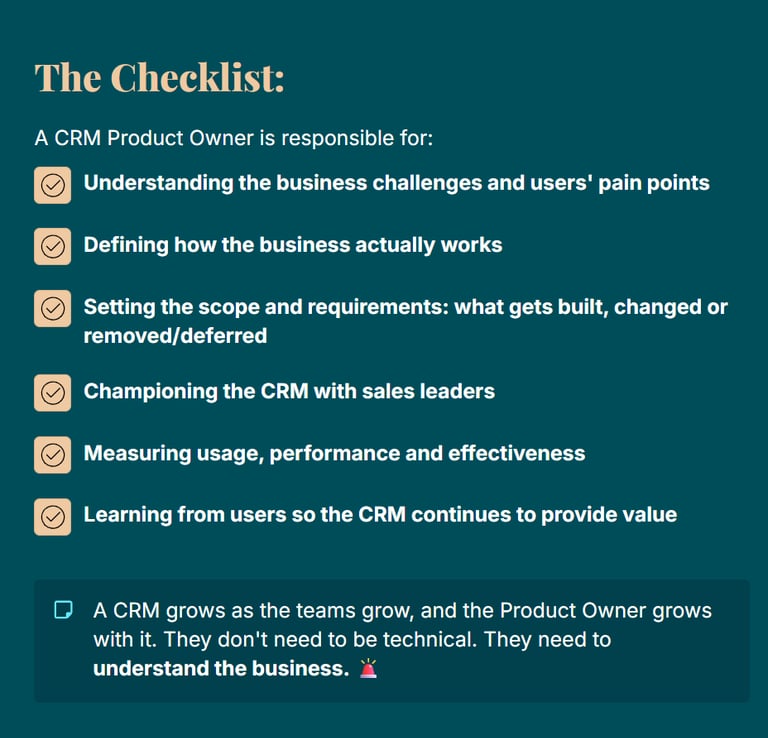
A CRM Product Owner is responsible for:
Understanding the business challenges and users’ pain points
Defining how the business actually works – the real process
Setting the scope and requirements: what gets built, changed or removed/deferred
Championing the CRM alongside sales leaders
Measuring CRM usage, performance and effectiveness
Learning from its users to ensure the CRM continues to provide value as the business evolves
A CRM grows as the teams grow, which means the Product Owner grows with it. They listen, learn and translate those insights into meaningful changes.
They are the person who:
Translates real‑world operations into CRM requirements
Protects the system from becoming a dumping ground
Makes decisions when teams disagree
They need to understand the business and they don’t need to be technical.
So who can be the product owner?
First of all, product ownership is a function, not a title.
A product owner is typically someone who understands the sales process in your organization; it may be someone from Sales Operations or someone from IT.
Ideally though, they sit close to the commercial process: Sales Operations, Revenue Operations, Pricing, a senior leader who understands how deals actually move, or sometimes a hybrid role between Sales + Ops
The title doesn’t matter. The function does.
It has to be someone who understands the business deeply enough to make decisions and is trusted enough that people follow them.
Because without a product owner, here’s what always happens:
The CRM becomes a suggestion box
Every team pulls in a different direction
CRM Admins get stuck guessing
And the system slowly stops matching the workflow
A CRM without a product owner isn’t a product. It’s a shared inbox.